
NE 011/98
National Standard for Electrical Voltage
Content
The National Standard realizes the volt (V) as a unit. Along with the ohm (Ω) (unit of electrical resistance), it defines the ampere (A) as the fundamental SI unit for electrical current in practical applications. The National Voltage Standard serves as the foundation of all derived electrical units in metrology. Since electrical voltage is the output quantity of most modern measuring instruments, this standard plays a critical role in the national economy.
DC Voltage Standard and Its Traceability
- The DC voltage standard covers the range from 100 mV to 10 V, with a DC voltage scale extending from 10 V to 1000 V.
- This standard is traceable through the Josephson voltage reference, measured at BIPM, ensuring the transfer of the unit in national metrological services.
- The DC voltage unit is maintained using a comparative method of three reference voltages.
- The National Standard for Voltage is internationally recognized, confirmed by direct comparisons with BIPM.
Technical Implementation and Equipment
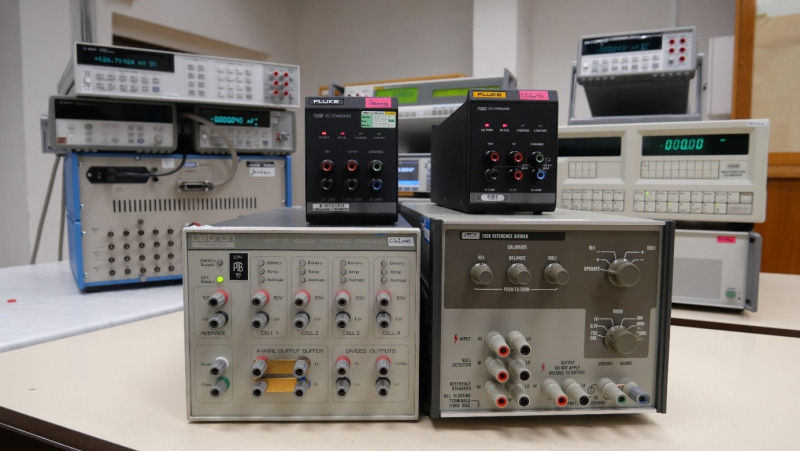
The voltage standard system consists of:
- Voltmeter: HP 3458A
- Reference Standard: Datron 4910
- Reference Standard: Fluke 732B
- Reference Standard: Fluke 732C
- Reference Divider: Fluke 752A
This state-of-the-art national standard ensures high precision and reliability, supporting calibrations and measurements across various scientific, industrial, and technological applications.
Documents for download
-
Osvedčenie (certifikát) (pdf, 688.2 kB)