
National Standard for Dosimetric Quantities of X-ray Radiation
Metrological Measurements of Dosimetric Quantities of X-ray Radiation
Metrological measurements of dosimetric quantities of X-ray radiation are performed in reference X-ray beams generated by an X-ray tube. X-ray radiation consists of an energy spectrum of electromagnetic radiation ranging from approximately 10 keV to 400 keV. By adjusting different filtration settings and the voltage generated by the X-ray tube, it is possible to shape the energy spectrum of X-ray radiation to the desired energy level.
The primary dosimetric quantities include:
- Air kerma (Ka) – determined by calculating the ionization charge (current) in an ionization chamber and measuring temperature, pressure, and humidity at the chamber location.
- Absorbed dose in water – essential for medical applications.
The determination of these quantities relies on either:
- The physical parameters of the ionization chamber and the air contained within it.
- The calibration factor of the ionization chamber.
The calculation process also incorporates various correction factors.
Significance of Air Kerma in X-ray Radiation
Air kerma (Ka) for X-ray radiation is a fundamental dosimetric quantity that plays a key role in ensuring the quality and accuracy of all dosimetric measurements. It is directly linked to:
- Ambient dose equivalent (H)*
- Personal dose equivalent (Hp(d))
- Dose rate values
These quantities are calculated based on international recommendations, standards, and procedures.
Measurement Corrections
To determine the dose rate at a given time, corrections are applied, primarily for:
- Temperature
- Pressure
- Radioactive decay
Air kerma is realized using free-in-air measurements with:
- Ambient dosimeters (freestanding instruments)
- Personal dosimeters (placed on a phantom simulating the human body)
The air kerma rate is linked to secondary ionization chamber standards that are further traced to international metrology institutes.
Composition of the National Standard for X-ray Radiation
The National Standard for X-ray Radiation consists of:
- Set of standard ionization chambers for measuring the air kerma rate.
- Transmission monitoring chamber PTW type 786.
- Standard ionization current meters (KEITHLEY 6517A).
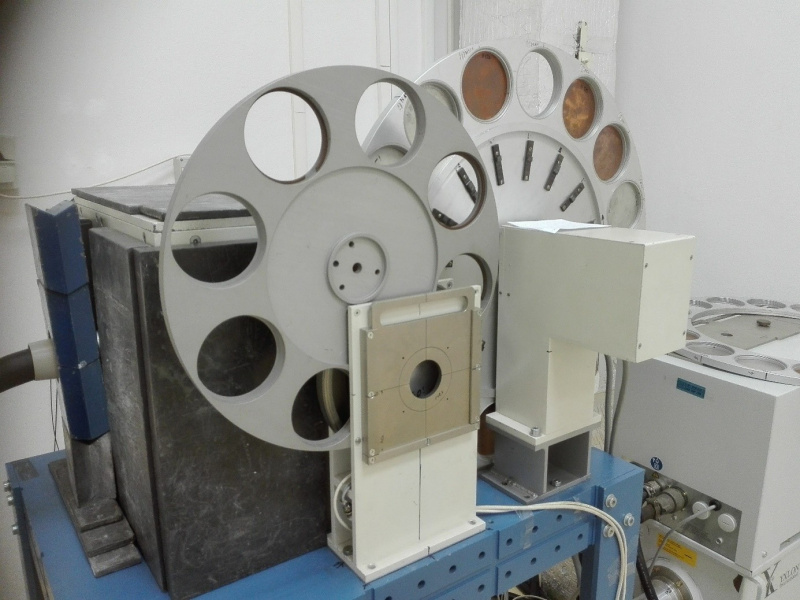
- Reference X-ray beams generated in an MG324 Philips irradiator with a Philips MCN 321 X-ray tube.
- Measurement bench with three-axis movement, allowing a maximum distance of 5 meters from the irradiator.
- Three sets of collimating diaphragms.
- Goodfellow energy filters for producing X-ray beams of selected narrow spectrum qualities (ISO 4037).
- Gammex RMI 115A filters for determining half-value layers.
- X-123 CdTe spectrometer for X-ray spectrum measurements.
- ISO PMMA and water phantoms.
- Atmospheric pressure, temperature, and humidity sensors (ALMENO) for monitoring laboratory conditions.
Basic Metrological Properties of the Standard for Narrow Spectra (40 – 300 keV)
| Quantity | Symbol | Range | Expanded Uncertainty (Uc, k=2) [%] |
|---|---|---|---|
| Air kerma in X-ray radiation | Ka | 5 × 10⁻⁴ Gy ÷ 5 × 10⁻¹ Gy | 1.6% |
| Air kerma rate in X-ray radiation | K̇a | 7.5 × 10⁻⁴ Gy·h⁻¹ ÷ 2.5 × 10⁻¹ Gy·h⁻¹ | 1.6% |
| Ambient dose equivalent | H* | 1 × 10⁻³ Sv ÷ 5 × 10⁻¹ Sv | 2.6% |
| Ambient dose equivalent rate | Ḣ* | 1 × 10⁻³ Sv·h⁻¹ ÷ 4 × 10⁻¹ Sv·h⁻¹ | 2.6% |
| Personal dose equivalent | Hp(d) | 5 × 10⁻³ Sv ÷ 5 × 10⁻¹ Sv | 2.6% |
| Personal dose equivalent rate | Ḣp(d) | 1 × 10⁻³ Sv·h⁻¹ ÷ 4 × 10⁻¹ Sv·h⁻¹ | 2.6% |
Documents for download
-
Osvedčenie (certifikát) (pdf, 1.1 MB)